
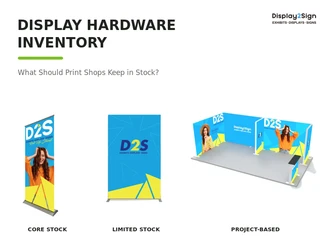
What Display Hardware Should Print Shops Keep in Stock?
Posted by Kira on Oct 15th 2026
What Display Hardware Should Print Shops Keep in Stock?
For a print shop, display hardware inventory should support print sales—not create another warehouse problem.
The goal is not to stock every available banner stand, backdrop size or booth system. It is to keep enough standardized hardware on hand to fulfill common projects quickly while leaving specialized and bulky systems for project-based purchasing.
A practical inventory normally has three levels:
| Inventory Level | Typical Products | Why |
|---|---|---|
| Core Stock | Retractable banner stands, common portable frames | Frequent orders, small storage footprint |
| Selective Stock | Pop up displays, standard fabric backwalls, folding SEG frames | Repeat demand but larger inventory footprint |
| Project-Based | Folding light boxes, large backwalls, modular booth systems | Higher value but more project-specific |
The right mix depends on the customers you serve, but the principle is consistent:
Stock standardized hardware that turns printed graphics into repeatable orders. Avoid tying up space and cash in configurations that customers request only occasionally.

Start With the Orders You Actually Repeat
Before adding hardware to inventory, review your recent display jobs.
Which products appear repeatedly?
For many print shops and sign companies, recurring requests are not complex custom exhibits. They are more likely to include:
-
Retractable banners
-
Portable backdrops
-
Fabric display walls
-
Pop up displays
-
Replacement graphics
-
Simple trade show display packages
These are useful inventory candidates because the hardware can support a predictable production workflow.
A specialized 20ft booth configuration may generate more revenue per order, but if it sells twice a year, it may not deserve permanent warehouse space.
Inventory should follow order frequency and hardware reuse, not product value alone.
1. Retractable Banner Stands Should Usually Be Core Stock
Retractable banner stands are one of the easiest display products for print shops to standardize.
They have several inventory advantages:
-
Small warehouse footprint
-
Familiar product format
-
Relatively simple graphic production
-
Common use across multiple industries
-
Easy bundling with other event graphics
-
Repeat demand for both hardware and graphics
Display2Sign currently offers Roll Up Banner Stands in several common formats, including 33", 36" and 48" widths.
For most print shops, that does not mean all sizes need equal inventory.
Make One Standard Size Your Primary SKU
A 33" class retractable stand is a practical candidate for a primary stocked size because it works for:
-
Trade shows
-
Conferences
-
Retail promotions
-
Lobby displays
-
Recruiting events
-
Corporate presentations
When customers do not have a specific size requirement, a standardized format also makes quoting and graphic production easier.
If you are deciding which widths deserve inventory, see What Size Retractable Banner Stand Do You Need?.

Keep Wider Formats Selective
A 48" stand gives designers more horizontal graphic space, but it also occupies more warehouse and shipping space.
Instead of stocking the same quantity of every width, a print shop might keep:
-
Higher quantity of standard narrow stands
-
Lower quantity of wider stands
-
Specialty sizes available as needed
This is usually more efficient than treating every SKU as equally important.
2. Keep Portable Backdrop Hardware in Standard Sizes
Backdrops are another natural extension of a print shop's graphic business.
Customers already buying fabric graphics, event branding or trade show materials often need the frame as well.
The challenge is that backdrop hardware takes more space than banner stands.
That makes size standardization important.
For many shops, 8ft and 10ft-class backdrops are more useful inventory candidates than carrying a large range of widths.
They cover common applications such as:
-
10x10 trade show booths
-
Conferences
-
Photo backdrops
-
Corporate events
-
Brand activations
-
Step-and-repeat-style applications
Display2Sign's Fabric Displays include portable fabric walls, pop up displays, folding SEG frames and other reusable display formats.
If you need to decide which widths are most useful, see What Size Trade Show Backdrop Do You Need?.
Do Not Stock Every Backdrop Width
A common inventory mistake is assuming more size options automatically improve service.
In practice, too many widths can create:
-
More SKUs
-
More replacement graphic specifications
-
More warehouse locations
-
More quoting complexity
-
Greater risk of picking the wrong hardware
A smaller standardized range is often easier to sell repeatedly.

3. Pop Up Displays Can Be Useful Selective Stock
Pop up displays are useful when customers want a larger backdrop but still expect portable hardware.
Their collapsible structure allows a relatively large display to pack into a smaller format, making them suitable for trade shows and temporary event projects.
Display2Sign offers portable pop up display formats within its Fabric Displays range.
For print shops, pop up systems make the most sense when customers regularly ask for:
-
Portable event walls
-
Full graphic backdrops
-
Quick-setup display packages
-
Complete frame-and-graphic solutions
They are less attractive as inventory when most customers only need occasional custom booth hardware.
Stock the Formats You Can Sell Repeatedly
If one pop up wall size accounts for most orders, standardize around it.
If demand is scattered across many configurations, project-based ordering may be more efficient.
For background on how this hardware works, see What Is a Pop Up Display? A Complete Guide.
4. Folding SEG Frames Are Worth Stocking When SEG Is Part of Your Business
A print shop already producing SEG graphics has a different hardware opportunity.
Instead of selling only replacement fabric, it can also offer the reusable frame.
Display2Sign's Folding SEG Frames are available in several portable widths, including 3ft, 4ft and 5ft-class frames.
The folding structure is particularly relevant for professional users because the frame remains connected during transport and opens without rebuilding the complete structure from separate profiles.
For print shops, that creates several advantages:
-
Hardware can be sold with the first graphic
-
Replacement graphics create future orders
-
Multiple frames can serve different project sizes
-
Portable packaging supports repeat event use
-
Standard frames can be reused across different clients or campaigns
This is a stronger B2B inventory model than simply selling one finished display once.
Think in Systems, Not Individual Frames
A 3ft, 4ft or 5ft frame should not be evaluated only as an individual SKU.
Ask whether customers can use the hardware for:
-
Standalone graphics
-
Side panels
-
Small backwalls
-
Connected display layouts
-
Future replacement graphics
If several sizes belong to one compatible system, the inventory becomes more useful.
Read What Is a Folding SEG Textile Frame Display? for more detail on the structure.

5. Folding Light Boxes Should Usually Be Selective Stock
Illuminated displays can generate higher-value projects, but that does not mean every print shop should keep large quantities on hand.
A Folding Light Box is a good option when customers want the visual impact of a backlit display combined with more portable hardware.
It can make sense to stock limited quantities when your customers regularly handle:
-
Trade shows
-
Retail promotions
-
Product launches
-
Premium event displays
-
Exhibition projects
But compared with a retractable banner, a folding light box:
-
Requires more warehouse space
-
Has electrical components
-
Costs more per unit
-
Is requested less universally
That usually makes it a selective inventory item rather than a high-volume core SKU.
For customers who regularly need portable illuminated graphics, the format can still be valuable because the frame can be reused while the graphics change.
See What Is a Folding Light Box? Portable Backlit Guide for the main differences.
6. Large Modular Light Box Systems Should Be Project-Based
Large modular systems are valuable, but they should be treated differently from commodity portable display hardware.
Display2Sign's Light Box Displays include modular SEG light box frames designed to work as standalone displays or as components in larger booth layouts.
This type of hardware makes sense when customers need:
-
8ft or 10ft illuminated walls
-
Connected light box structures
-
Larger booth layouts
-
Repeatable modular configurations
-
Counters and compatible accessories
For most print shops, however, carrying deep inventory across every frame and accessory combination creates unnecessary complexity.
The better approach is usually:
sell the project first, then pull the required system components.
That keeps capital focused on frequently moving products while still allowing the shop to offer larger exhibit solutions.
Core Stock vs Project-Based Stock
A useful inventory model might look like this:
| Hardware | Recommended Inventory Approach |
|---|---|
| 33" Retractable Banner | Core Stock |
| 36" / 48" Retractable Banner | Selective Stock |
| Standard 8ft / 10ft Fabric Backdrop | Core or Selective Stock |
| Pop Up Display Wall | Selective Stock |
| Folding SEG Frames | Core or Selective if SEG is a major category |
| Folding Light Box | Selective Stock |
| Large Light Box Frames | Project-Based |
| Complete Booth Systems | Project-Based |
| Specialty Connectors / Accessories | Based on system usage |
This is not a universal stocking formula.
The important point is the hierarchy.
High-frequency, standardized hardware deserves permanent inventory.
Low-frequency, configuration-dependent hardware does not.

Replacement Graphics Should Influence What You Stock
For print shops, one of the strongest reasons to sell display hardware is that the hardware can create future print orders.
A frame sold today may later need:
-
A new campaign graphic
-
A new product graphic
-
Event-specific artwork
-
Rebranding
-
Replacement fabric
This is why reusable display systems are more strategically useful than disposable hardware.
Before stocking a frame, ask:
Can we sell graphics for this same hardware again?
If the answer is yes, the inventory supports recurring print revenue.
This is especially relevant for:
-
Retractable banner hardware
-
Tension fabric frames
-
Folding SEG frames
-
Light boxes
The hardware should be viewed as the installed base that supports future graphic orders.

Standardize Graphic Specifications Where Possible
Every additional hardware variation can create another graphic specification.
For example, carrying five nearly identical banner widths can mean maintaining:
-
Five artwork templates
-
Five finished graphic sizes
-
Five hardware SKUs
-
Five replacement graphic specifications
That may be justified if demand exists.
If not, it adds complexity without creating meaningful customer value.
Standardized hardware helps a print shop build repeatable production processes.
That can improve:
-
Quoting
-
Prepress
-
Production
-
Finishing
-
Order picking
-
Replacement orders
For this reason, inventory decisions should involve the production team—not only sales.
Avoid Overstocking Low-Frequency Sizes
One of the easiest ways to create inefficient display inventory is to stock every available size “just in case.”
A better approach is to separate products into three groups.
A Items: Frequent Sellers
Keep reliable inventory.
Examples may include:
-
Standard retractable banners
-
Common backdrop widths
-
Frequently sold portable frames
B Items: Regular but Lower-Volume Sellers
Keep smaller quantities.
Examples may include:
-
Wider banner stands
-
Pop up displays
-
Folding SEG frames
-
Folding light boxes
C Items: Project Products
Order against confirmed demand.
Examples may include:
-
Large illuminated walls
-
Complete booth kits
-
Specialty configurations
-
Less common sizes
This simple classification keeps warehouse space aligned with actual customer demand.
Think About Warehouse Density
Hardware should also be evaluated by how much revenue opportunity it occupies per unit of storage.
Twenty retractable banner stands may use less space than a few large booth systems.
That does not mean small hardware is always more profitable, but it does mean bulky inventory needs a stronger reason to stay in stock.
Ask:
-
How many units fit in a standard rack location?
-
Can similar products stack safely?
-
How easily can staff identify the SKU?
-
Does the hardware require multiple cartons?
-
How long does it typically stay in inventory?
Warehouse efficiency becomes increasingly important as the hardware range grows.
Consider Shipping Before Adding a SKU
A product may be easy to store but expensive or inconvenient to ship.
Before standardizing hardware, check:
-
Packed length
-
Packed weight
-
Number of cartons
-
Parcel vs freight requirements
-
Damage risk
-
Protective packaging
This is especially relevant for print shops serving customers outside their local market.
A hardware SKU that ships easily can support a much broader customer base than one that requires special freight handling.
Build Inventory Around Common Project Packages
Instead of thinking only in individual SKUs, consider the combinations customers regularly buy.
For example:
Basic Event Package
-
1 retractable banner
-
Printed graphic
Standard 10x10 Package
-
8ft or 10ft backdrop
-
1 counter
-
1 retractable banner
Portable SEG Package
-
Folding SEG backwall
-
Replacement graphic option
-
Supporting banner or counter
Portable Illuminated Package
-
Folding light box
-
Counter
-
Supporting graphic
This approach makes it easier for sales teams to recommend complete solutions while keeping the underlying hardware standardized.
If you are deciding how different portable systems fit different projects, read How to Choose a Portable Trade Show Display.

What Should Print Shops Avoid Keeping in Deep Stock?
Not every display product needs to be available immediately.
Be cautious about deep inventory in:
-
Unusual sizes
-
Highly specialized frames
-
Large booth-specific configurations
-
Low-frequency accessories
-
Products with no clear replacement graphic opportunity
-
Multiple SKUs that solve essentially the same customer need
A wide catalog can still be useful.
But catalog availability and warehouse availability do not need to be the same thing.
That distinction allows a print shop to offer a broader product range without carrying every item physically.
How Often Should You Review Display Hardware Inventory?
Display hardware inventory should not remain fixed indefinitely.
Review it periodically against:
-
Sales frequency
-
Quote frequency
-
Stock turnover
-
Replacement graphic orders
-
Customer requests
-
New event formats
-
Dead inventory
If one size receives frequent quotes but few orders, investigate why.
If another SKU generates repeated replacement graphic business, it may deserve more inventory even if the initial hardware margin is modest.
The best inventory decisions come from actual customer behavior.
A Practical Stocking Framework
For many print shops, a sensible starting structure is:
Keep in Core Stock
-
Standard retractable banner stands
-
One or two high-demand portable backdrop formats
-
Frequently used accessories
Keep in Limited Stock
-
Wider or taller banner stands
-
Pop up display walls
-
Standard folding SEG frames
-
Folding light boxes if customer demand supports them
Order by Project
-
Large light box frames
-
Full modular booths
-
Specialty dimensions
-
Less common accessories
-
Complex exhibit configurations
Then adjust the mix using your own order data.
Final Thoughts
A good display hardware inventory is not the largest inventory.
It is the inventory that supports the greatest number of profitable, repeatable customer projects with the least unnecessary complexity.
For most print shops, that means keeping standardized portable hardware close at hand while treating larger and more specialized exhibit systems as project-based products.
Start with hardware that:
-
Sells repeatedly
-
Stores efficiently
-
Supports replacement graphics
-
Uses standardized specifications
-
Works across multiple customer types
Then add more specialized systems only when demand justifies them.
The key inventory question is not:
“How many display products can we offer?”
It is:
“Which hardware helps us produce and sell more graphics across repeated customer projects?”
That is the point where display hardware becomes more than an accessory sale—it becomes part of a repeatable print business.