
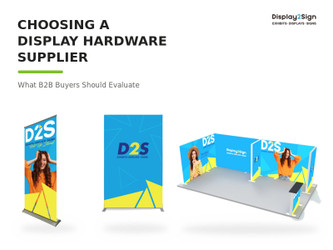
How to Choose a Trade Show Display Hardware Supplier
Posted by Kira on Nov 4th 2026
How to Choose a Trade Show Display Hardware Supplier

Choosing a trade show display hardware supplier is different from choosing a single display product.
A frame can look good in a catalog and still create problems when you need the same hardware again six months later, a replacement connector before an installation, or twenty matching units for a multi-location project.
For exhibit companies, print shops, sign shops and display distributors, the supplier becomes part of the project workflow.
The right supplier should help you answer questions such as:
-
Can the same hardware be reordered consistently?
-
Are common products actually in stock?
-
Can individual components be replaced?
-
Will different frames and accessories work together?
-
Can the supplier support larger quantities?
-
How predictable are packing and shipping?
-
Is technical support available when a project becomes more complex?
The lowest unit price does not necessarily create the lowest project cost.
A better way to evaluate a supplier is to look at how well its hardware, inventory and support fit your repeat business.
1. Check What Is Actually in Stock
A large product catalog does not automatically mean strong inventory.
For professional buyers, the more important question is:
Which products can the supplier consistently fulfill when a project is confirmed?
This matters because trade show timelines are often fixed. Once the event date is established, delays in hardware can affect:
-
Graphic production
-
Test fitting
-
Packing
-
Freight scheduling
-
Installation
-
Client delivery
Ask the supplier which categories are regularly stocked rather than assuming everything shown online is immediately available.
Common inventory may include:
-
Retractable banner stands
-
Portable fabric backwalls
-
Pop up displays
-
Standard SEG frames
-
Light box frames
-
Common bases and connectors
Special booth configurations may reasonably be handled differently.
The key is transparency.
A supplier should make it possible to distinguish between standard stocked hardware and products that require additional lead time.
2. Evaluate Lead Time Consistency, Not Just the Fastest Quote
Fast shipping is useful.
Predictable shipping is more important.
A supplier that occasionally ships very quickly but regularly changes fulfillment times can make project planning difficult.
Professional buyers should evaluate:
-
Typical processing time
-
Stock availability
-
Shipping origin
-
Cutoff policies
-
Large-quantity lead times
-
What happens when one warehouse is out of stock
-
Whether lead times change significantly by SKU
The objective is not to find a supplier promising the shortest possible number.
It is to find one whose fulfillment performance can be built into your own project schedule.
For repeat trade show projects, consistency reduces the amount of safety time your team needs to add to every order.

3. Look for Standardized Hardware
Repeat purchasing becomes much easier when hardware specifications remain consistent.
Imagine purchasing the same 10ft display twice, one year apart.
Ideally, the second order should match the first in the areas that affect:
-
Graphic dimensions
-
Frame connections
-
Feet
-
Accessories
-
Replacement parts
-
Packing
If specifications change frequently without clear version control, replacement orders become more difficult.
For print shops, this can be especially disruptive because the graphic is produced around the hardware specification.
A seemingly minor change in:
-
Frame width
-
Graphic finishing
-
SEG channel
-
Base dimensions
-
Connector position
can affect production.
When evaluating a supplier, ask whether its main product systems use stable, documented specifications.
4. Check Whether Products Belong to a Compatible System
A professional hardware supplier should offer more than a collection of unrelated products.
System compatibility becomes increasingly important as project volume grows.
For example, a modular SEG system may include:
-
Frames
-
Bases
-
Connectors
-
Counters
-
TV mounts
-
Reinforcement components
-
Accessories
The value comes from these products working together.
A 10ft frame should not always be viewed as an isolated SKU.
It may be part of a larger hardware platform that can later support:
-
An L-shaped configuration
-
A 10x20 booth
-
A storage counter
-
A larger illuminated wall
This can reduce the number of completely separate systems you need to purchase over time.
For projects where booth configurations change regularly, compatibility can be more valuable than saving a small amount on one individual frame.
See the SEG Light Box System when evaluating how compatible frames, counters and accessories can work within one modular platform.
5. Ask About Replacement Parts Before You Need Them
Replacement parts are easy to overlook during the first purchase.
They become much more important after the hardware has been used repeatedly.
Common issues may involve:
-
Lost connectors
-
Damaged feet
-
Bent support components
-
Missing hardware
-
Worn accessories
-
Electrical components on illuminated systems
A professional buyer should ask:
Can I replace the damaged component, or do I need to replace the complete display?
This has a major effect on long-term hardware cost.
For rental companies and exhibit houses, repairability also affects utilization.
If one small component takes an entire frame out of service, the cost is not only the replacement hardware.
It may also mean a missed rental or project delay.
Before standardizing around a system, check whether commonly used components are available separately.

6. Check Graphic Replacement Support
Display hardware often lasts longer than the graphic installed on it.
Graphics may change because of:
-
Rebranding
-
New products
-
Seasonal campaigns
-
Different events
-
Different customers
For this reason, the supplier should make it easy to identify the correct replacement graphic specification.
This is particularly important for:
-
SEG frames
-
Light boxes
-
Tension fabric displays
-
Retractable banner hardware
For print shops, replacement graphics are also part of the business model.
Selling reusable hardware can create future print orders when the customer returns with a new campaign.
A good display hardware supplier should therefore help make the relationship between frame specification and graphic specification clear.
7. Compare Packed Size and Freight Requirements
Display hardware should not be evaluated only by its finished size.
A 10ft display may be compact when packed—or it may require several long cartons.
That difference affects:
-
Freight cost
-
Parcel eligibility
-
Warehouse space
-
Vehicle loading
-
Job-site handling
Before choosing a supplier, review how its products are packed.
Ask:
-
How many cartons are required?
-
What is the packed length?
-
Are cases or bags included?
-
Can several frames be consolidated?
-
Is special freight required?
-
How well are components protected?
For professional buyers shipping displays to customers or venues, freight efficiency can affect project margin just as much as hardware price.
Portable products should be evaluated especially carefully.
If transportation and repeated setup are major concerns, see How to Choose a Portable Trade Show Display.
8. Consider Whether the Supplier Supports Repeat Projects
One successful order does not tell you whether a supplier is suitable for long-term use.
Repeat projects test different capabilities.
A supplier needs to support:
-
Reorders
-
Matching hardware
-
Additional quantities
-
Replacement parts
-
New graphics
-
Expansion into larger configurations
This becomes important when a customer begins with one display and later asks for more.
For example:
Project 1: one 10ft backdrop
Project 2: additional frames
Project 3: a larger booth
Project 4: replacement graphics and accessories
If every stage requires moving to a completely unrelated hardware system, the original purchase provides limited long-term value.
A supplier with reusable systems can make expansion easier.
For more on this purchasing logic, see How to Choose Display Hardware for Repeat Trade Shows.

9. Evaluate Quality Consistency Across Orders
Professional buyers need consistency more than they need one perfect sample.
A supplier may produce an excellent first unit, but repeat purchasing creates another question:
Will the next batch match?
Quality consistency matters for:
-
Profile finish
-
Frame dimensions
-
Connection fit
-
Base stability
-
Accessories
-
Graphic compatibility
-
Packaging
This becomes especially important when hardware purchased at different times needs to work together.
Exhibit companies and rental businesses should pay particular attention to interchangeability.
If two frames are supposed to belong to the same system, they should not require project-by-project adjustments to function together.
10. Do Not Judge Hardware Quality by Weight Alone
Heavier hardware is not automatically better hardware.
Lighter hardware is not automatically more portable.
Evaluate the complete design.
Useful questions include:
-
Does the frame remain rigid when installed?
-
Are the connection points stable?
-
Are bases appropriate for the finished size?
-
Does the system withstand repeated assembly?
-
Are components designed for replacement?
-
Is the packing suitable for repeated transport?
A well-designed portable system may intentionally reduce weight.
A modular booth system may require more structural components because it supports larger configurations.
Hardware should be judged against the job it is designed to perform.
11. Make Sure the Supplier Can Support Multiple Project Levels
A professional customer rarely handles only one display type.
A print shop may begin with:
-
Retractable banners
-
Portable backdrops
and later receive requests for:
-
SEG frames
-
Folding light boxes
-
Complete booths
An exhibit company may need both:
-
Simple portable displays
-
Modular systems
Working with a supplier that supports several project levels can simplify purchasing.
The important point is not having thousands of unrelated products.
It is having logical progression between product categories.
A supplier might support:
portable display → premium folding frame → illuminated display → modular booth system
That makes it easier to keep more projects within a familiar hardware ecosystem.
Display2Sign's Fabric Displays, Folding Light Boxes, SEG Folding Frame System and SEG Light Box System represent these different levels of project complexity.
12. Check Whether Volume Pricing Fits Your Business Model
B2B hardware purchasing should not be structured like one-piece consumer retail.
If your company regularly buys multiple units, evaluate whether the supplier supports:
-
Quantity pricing
-
Trade pricing
-
Distributor pricing
-
Repeat purchasing
-
Larger project quotes
The important point is predictability.
A professional buyer should be able to understand how pricing changes as quantity increases.
This is especially relevant when quoting your own customer.
If the supplier's pricing only becomes clear after the project has already been sold, protecting margin becomes more difficult.
Volume pricing also matters for standard inventory.
Print shops and distributors purchasing common banner stands or portable frames repeatedly should be able to benefit from consolidated buying.
13. Do Not Compare Suppliers by Unit Price Alone
Consider two frames.
Supplier A is cheaper by $20.
Supplier B provides:
-
Consistent stock
-
Replacement parts
-
Standard specifications
-
Better packing
-
Compatible accessories
-
More predictable repeat orders
The lower-priced frame may still be the right choice.
But the $20 difference is not enough information to make the decision.
The real project cost can include:
hardware + freight + setup labor + replacement parts + storage + damaged inventory + future compatibility
For repeat B2B projects, these costs accumulate.
Compare total workflow cost rather than only the initial purchase price.
14. Evaluate Technical Support
Support becomes increasingly important as projects become more complex.
For a standard retractable banner, very little technical assistance may be required.
For a modular booth, customers may need help with:
-
Frame selection
-
Connector selection
-
Configuration
-
Bases
-
Accessories
-
Compatibility
A supplier serving professional display businesses should understand how its hardware works as a system.
Technical support is especially useful before the order.
Identifying a missing connector after the booth reaches the venue is too late.
For complex projects, ask whether the supplier can help verify the bill of materials before shipment.
15. Check Whether the Supplier Understands B2B Buyers
A supplier focused on professional customers should understand that different buyers have different requirements.
Print Shops
Often care about:
-
Graphic specifications
-
Standardized hardware
-
Replacement graphics
-
Repeat orders
See What Display Hardware Should Print Shops Keep in Stock? for a more detailed inventory approach.
Exhibit Companies
Often care about:
-
Compatibility
-
Reconfiguration
-
Replacement parts
-
Installation
-
Project scalability
Rental Companies
Often care about:
-
Durability
-
Repairability
-
Inventory utilization
-
Standardization
-
Multiple configurations
Distributors
Often care about:
-
Availability
-
Consistent specifications
-
Trade pricing
-
Fulfillment
-
Product range
A supplier does not need a completely different product catalog for each customer type.
But it should understand how professional buyers actually use the hardware.
16. Look at the Supplier's Product Architecture
One of the most useful ways to evaluate a display supplier is to ignore individual product photos for a moment and look at the overall product architecture.
Ask:
-
Are there clear product families?
-
Are related accessories easy to identify?
-
Are dimensions standardized?
-
Can products be expanded?
-
Are replacement components available?
-
Can one system support several applications?
A supplier with clear system architecture is generally easier to work with over time than one with hundreds of unrelated products.
This becomes more important as your own hardware inventory grows.
17. Check the Supplier Before Standardizing Your Own Inventory
Once your company commits to a display system, switching suppliers can become expensive.
Existing inventory may include:
-
Frames
-
Graphics
-
Spare components
-
Cases
-
Accessories
-
Artwork templates
Before making one supplier's hardware part of your standard offering, test more than the first product.
Consider placing orders that evaluate:
-
Product quality
-
Packing
-
Graphic fit
-
Reorder consistency
-
Parts availability
-
Communication
-
Delivery reliability
The objective is to understand how the relationship works after the first sale.
Supplier Evaluation Checklist
Before choosing a trade show display hardware supplier, check:
-
Are commonly ordered products actually stocked?
-
Are lead times predictable?
-
Do product specifications remain consistent?
-
Do frames and accessories belong to compatible systems?
-
Can replacement components be ordered separately?
-
Can graphics be replaced without replacing the frame?
-
Is packaging suitable for repeated shipping and handling?
-
Can the supplier support larger repeat orders?
-
Is quantity or trade pricing available?
-
Can technical support help with complex configurations?
-
Can the hardware expand into future projects?
-
Does the supplier understand professional display workflows?
If several of these answers are unclear before the first order, they are unlikely to become easier when the project is under deadline.
Final Thoughts
Choosing a trade show display hardware supplier is ultimately a supply-chain decision, not just a product decision.
The best supplier for a professional buyer should help reduce uncertainty across repeated projects.
Look for a partner that can provide:
-
Reliable availability
-
Consistent specifications
-
Compatible hardware
-
Replacement components
-
Practical packaging
-
Predictable B2B pricing
-
Technical support
-
Room to expand into larger projects
The most important question is not:
“Who sells this frame for the lowest price?”
It is:
“Can this supplier support the way our business buys, builds, ships and reuses display hardware over time?”
For exhibit companies, print shops, rental businesses and distributors, that difference determines whether a hardware supplier remains useful after the first order.